
Draghilev's method - Solving systems of nonlinear equations. - Messaggi

Wrote
To be honest, in order to replace Mathcad (Prime) and use SMath completely in my teaching, I need only few more things (like nonlinear curve fitting) but time is passing and I am still waiting o_o . I have enough time for that, but would like to be ASAP.
It is easily to find out that these few things are needed for majority of the engineering math and modeling problems. SMath's visual capabilities are very attractive for engineering applications.
- system of linear equations (SMath - should be improved)
- system of nonlinear equations (SMath - roots(), not good enough - plugin made by w3b5urf3r)
- system of first order ODE (SMath - plugin made by uni, improving appreciated)
- interpolation (SMath - included, should be improved)
- differentiation, integration (SMath - should be improved)
- linear and nonlinear curve fitting (SMath - not included, neither plugins made)
- 2D and 3D plotting (SMath - should be improved)
- units (SMath - quite good enough)
Hi omorr, this is a useful reference for Andrey and plugin developers.
Could you elaborate more each section ? by specifying which features should be added/improved/corrected.

I hope you would not mind, but I suggest you to search the Forum and to see some of my posts. As you could see, there are almost one thousand of them (I sometimes hesitate to post because of being annoying with so many of them). Whatever I would write here, would be repeating the things I already mentioned. By the way, you also mentioned and posted many links to numerical algorithms and methods
 . I respect any developer who is willing to put all those methods and keep them "alive" in SMath, but eventually it will take quite a long time.
Actually, the priorities in SMath development are up to the Andrey's decisions and he knows the best about it.
Regards,
Radovan

Draghilev's method. NLS. Example 2.smz (6,13 KiB) scaricato 1346 volta(e).
Now, every F9 produces result for your test problem.
Regards,
Radovan
Draghilev's method. NLS. Example 2.smz (6,17 KiB) scaricato 1329 volta(e).
It is quite interesting that you've made it working with 20 points
.By the way, I've added the sum of squares - just to check how this sum reduces its value.
Regards,
Radovan
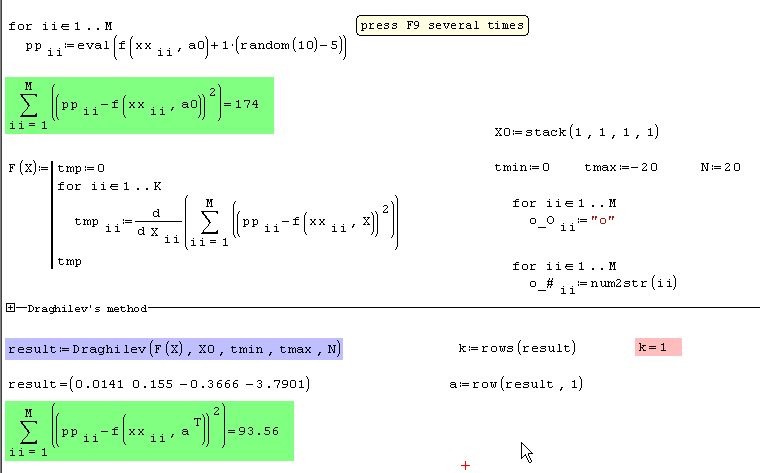


WroteYes, but initial value for a is X0 := stack(1, 1, 1, 1)
Sorry, uni, my mistake
 . Graph distracted me
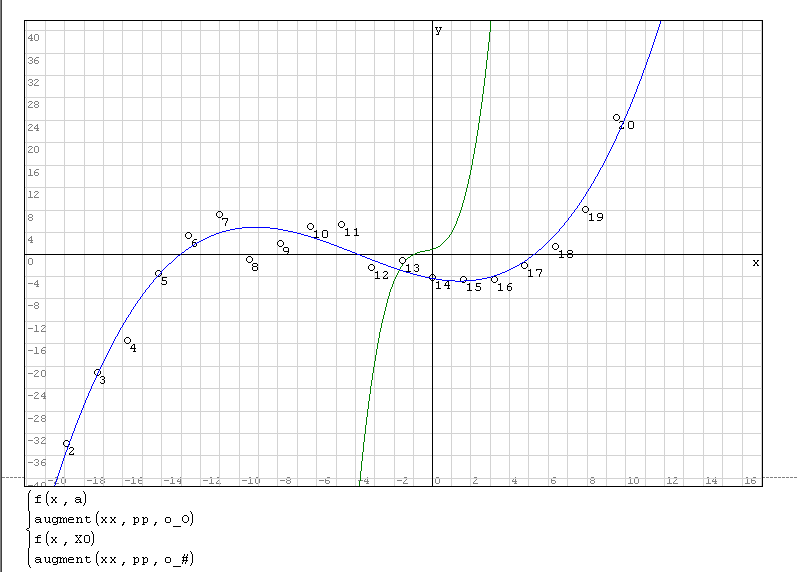
In this example - this is really amazing

If this could work for a bit more complicates functions - it would be really great
.Regards,
Radovan
Wrote
By the way, I bumped many times into the derivative, gradient, Jacobian problem in SMath and almost always had to give it up. I even asked Andrey few times to introduce numerical differentiation in spite of the well known fact that numerical differentiation is prone to numerical errors. Calculating even derivatives (Jacobian is another nightmare) analytically is sometimes almost impossible and there is no other way than using some kind of numerical approximation. Therefore, when Jacobian is involved in some calculation - I always find myself unconfortable
Please look at these matlab algorithms:
See pdfpage 112/docpage 90 of this document for a jacobian approximation by finite difference
http://www.dsic.upv.es/docs/bib-dig/tesis/etd-10272003-001792/TesisEnriqueArias.pdf
Adaptive Robust Numerical Differentiation (matlab code)
http://www.mathworks.com/matlabcentral/fileexchange/13490-adaptive-robust-numerical-differentiation
CitazioneThank you for considering this
[MATH=eng]sum(((el(pp,i)-f(el(xx,i),a1,a2,a3))*diff((f(el(xx,i),a1,a2,a3)),a1)),i,1,n)≡0[/MATH]
[MATH=eng]sum(((el(pp,i)-f(el(xx,i),a1,a2,a3))*diff((f(el(xx,i),a1,a2,a3)),a2)),i,1,n)≡0[/MATH]
[MATH=eng]sum(((el(pp,i)-f(el(xx,i),a1,a2,a3))*diff((f(el(xx,i),a1,a2,a3)),a3)),i,1,n)≡0[/MATH]
It is a well known and maybe redundant to say, sorry - the first derivatives over three unknowns (a1,a2,a3) should be zero
Now I knew where it came from. I also fixed a bug with double index ii. I've used it twice.
Draghilev's method. NLS. Example 2.1.smz (6,41 KiB) scaricato 1313 volta(e).
It seems very promising
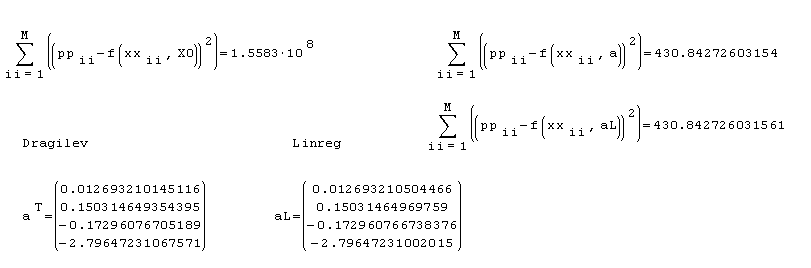
As it is basically a linear regression over parameters (polynomial equation) I just added the result of it - just for checking. The results are very close to each other. It is interesting that the method is working on this problem very well
The determinant [MATH=eng]det((transpose(XX)*XX))=2.40082615642816*10^16[/MATH]is rather far from zero - well conditioned system. I suppose that would be very interesting to see what will happen when this determinant is quite close to zero - ill conditioned system. I suppose that the results must be quite different.
Regards,
Radovan
CitazioneI suppose that would be very interesting to see what will happen when this determinant is quite close to zero - ill conditioned system. I suppose that the results must be quite different.
Yes, it would be interesting. I'll try to find an example. To improve accuracy, we can increase the parameter N. As for the more complex functions, I'm working on it.
WroteWrote
By the way, I bumped many times into the derivative, gradient, Jacobian problem in SMath and almost always had to give it up. I even asked Andrey few times to introduce numerical differentiation in spite of the well known fact that numerical differentiation is prone to numerical errors. Calculating even derivatives (Jacobian is another nightmare) analytically is sometimes almost impossible and there is no other way than using some kind of numerical approximation. Therefore, when Jacobian is involved in some calculation - I always find myself unconfortable
Please look at these matlab algorithms:
See pdfpage 112/docpage 90 of this document for a jacobian approximation by finite difference
http://www.dsic.upv.es/docs/bib-dig/tesis/etd-10272003-001792/TesisEnriqueArias.pdf
Adaptive Robust Numerical Differentiation (matlab code)
http://www.mathworks.com/matlabcentral/fileexchange/13490-adaptive-robust-numerical-differentiation
Thank you for the links. Actually, that is the point. At the moment, many plugins which rely on symbolic derivative, gradient, Jacobian, Hessian have great chance to fail sometimes due to the SMath symbolic restrictions and features or simply due to a complicated expressions obtained. There were many situations when you can actually have the numerical values of a vector valued function, but you can not have the derivatives of its elements (therefore, can not calculate Jacobian, Hessian etd.) and every method who use this will also fail (take a look for instance at the efforts of w3b5urf3r an the Nonlinear-solvers plugin). We can actually make Jacobian function ourselves (like the one very simple and hardly useful as in the attached example), but I think that is not the point. Numerical derivation methods are quite prone to errors and I would very like that someone make a plugin (based on some more sophisticated algorithms) like the one mentioned in your second link.
Regards,
Radovan
Jacnum.sm (16,39 KiB) scaricato 1306 volta(e).
The solution here is: [28.4502559095434933, -2720.12633981294994, -7.01208324395984839]. Maybe later I'll be able to get it.
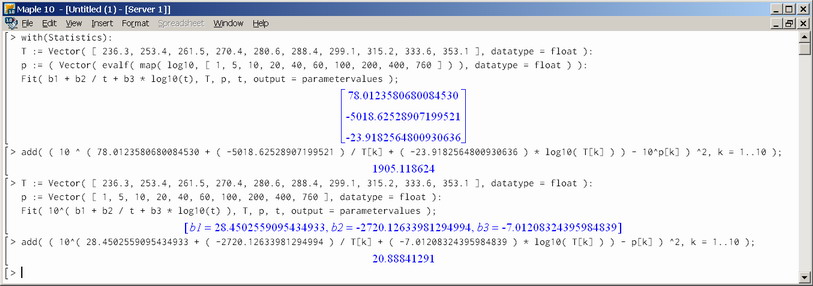 ,
I think it is good enough that you solved many other examples including this particular problem
 .
Regards,
Radovan
Be happy.Wrote... not worry... uni
[MATH]sys(x^2-y*x+y^2-1=0;sin(5*x^2)+sin(4*y^2)=0;2;1)[/MATH]
Draghilev's method. Finding roots. System 1. MC15_M010_20110622.zip (283,54 KiB) scaricato 406 volta(e).
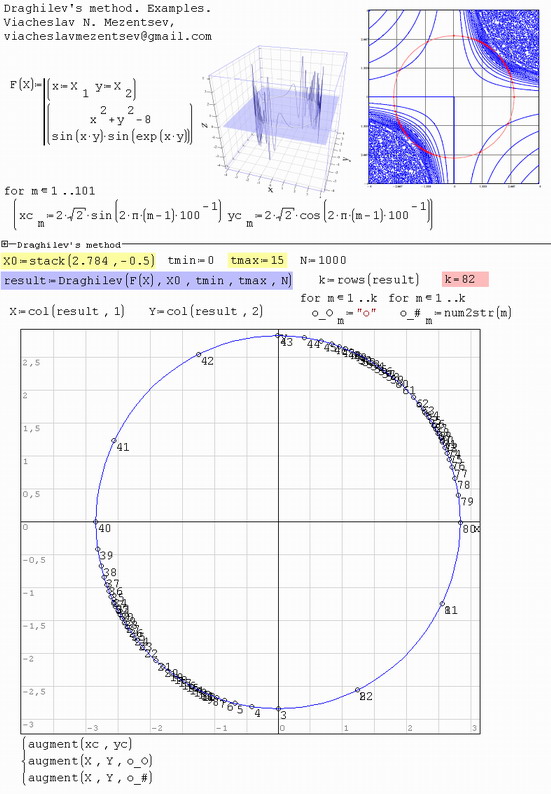
[MATH]sys(x^2+y^2-8=0;sin(x*y)*sin(exp(x*y))=0;2;1)[/MATH]
I made minor changes to simplify the calculations. Function has become more clear.
Calculation time: ~1.5 min
Roots: 80
One equation with two unknowns or implicitly given function. In the figure we can see the points at which violated the conditions of existence of an implicit function.
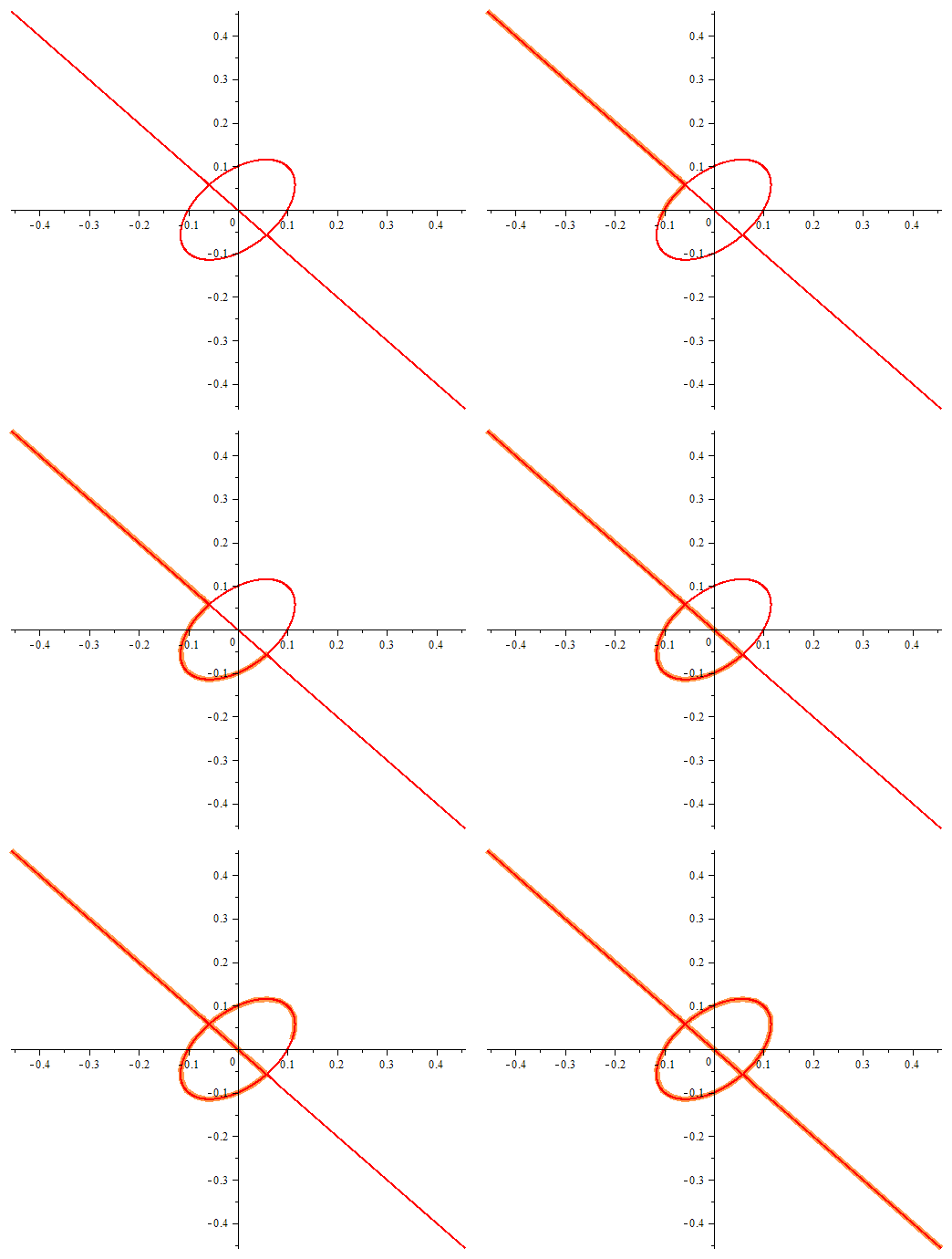
Draghilev's method.
x1 and x2 are solutions of this equation and are functions of the arc length, which allows a clear move along places where there are no implicit function in the classically accepted terms …
Draghilev's method. Finding roots. System 0.sm (348,46 KiB) scaricato 1350 volta(e).
Draghilev's method. Finding roots. System 0.pdf (316,26 KiB) scaricato 826 volta(e).
Draghilev's method. Finding roots. System 1.sm (324,18 KiB) scaricato 1321 volta(e).
Draghilev's method. Finding roots. System 1.pdf (329,05 KiB) scaricato 788 volta(e).
Draghilev's method. Finding roots. System 2.sm (29,84 KiB) scaricato 1285 volta(e).
Draghilev's method. Finding roots. System 2.pdf (91,89 KiB) scaricato 718 volta(e).
Draghilev's method. Finding roots. System 3.sm (306,66 KiB) scaricato 1317 volta(e).
Draghilev's method. Finding roots. System 3.pdf (306,07 KiB) scaricato 774 volta(e).
Draghilev's method. Finding roots. System 4.sm (69,86 KiB) scaricato 1314 volta(e).
Draghilev's method. Finding roots. System 4.pdf (160,39 KiB) scaricato 721 volta(e).
- Nuovi post
- Nessun nuovo post