
Problem in X-Y Plot - Mensajes

Again I recur to the Question Forums to attempt to solve an issue that I, single handely, cannot fix.
The issue I'm attempting to solve revolves around the definition of the movement of a certain bell, and the Horizontal forces produced by such movement.
In the attempt of solving this issue, I recurred to "Cephes Mathematical Library" Plugin, due to the necessity of implementing Jacobian Elipting Functions, as they are vital to obtain a more accturate discription of reality.
The problem I'm encountering is that the graph I create does not show anything at all, no matter how much I increase the frame window, or force parameters in the functions and equations I utilize.
I know this is quite the niche problem, but, if anyone has encountered similar problems as I have, I would be happy to hear solutions or steps to one.
I'll annex the SMath file for further investigation if necessary.
Much appreciated.
Frequency Analysis_v1.sm (15,7 KiB) descargado 1855 vez(es).
WroteThe problem lies with the sine function. Your argument to the sine function has units. It needs to be unitless.
Thank you very much for the assistance. I understanad what you're saying, but how do I resolve that issue? I'm kind of lost.
Thanks in advance for the assistance
WroteWroteThe problem lies with the sine function. Your argument to the sine function has units. It needs to be unitless.
Thank you very much for the assistance. I understanad what you're saying, but how do I resolve that issue? I'm kind of lost.
Thanks in advance for the assistance
There seems to be an error in the expression for phi(t). However, I would need to see how it was derived to stand a chance of helping further.
Frequency Analysis_v1.sm (154,3 KiB) descargado 1871 vez(es).
Best regards.
Alvaro.
WroteWroteWroteThe problem lies with the sine function. Your argument to the sine function has units. It needs to be unitless.
Thank you very much for the assistance. I understanad what you're saying, but how do I resolve that issue? I'm kind of lost.
Thanks in advance for the assistance
There seems to be an error in the expression for phi(t). However, I would need to see how it was derived to stand a chance of helping further.
Hello again, I took the expression from the agllomerate of a couple of thesis work I discovered when studying the process. As the actual derrivation is quite complicated, but was common between papers, I didn't bother for it's confirmation.
Nevertheless, could you point me the error for the expression in phi(t)?
Thanks in advance.
WroteOlá João. Some notes in the attached file.
Frequency Analysis_v1.sm (154,3 KiB) descargado 1871 vez(es).
Best regards.
Alvaro.
Alvaro, very much appreciate the efforts you placed in a project that doesn't affect you in any way, it is very much appreciated.
Nevertheless, I do have some questions behind some of the processes you did. Firstly, I believe you changed the sn( 1; 2) function I utilized to a simpler sin() function, I must ask if that was mostly due to simplification of the analytical processes or if there was any other reasoning behind it.
Secondly, you refer that phi(t)' and phi(t)'' have different units and, therefore, H(t) will be incorrect. How could one attempt to resolve that issue?
Thank you very much in advance.
Wrote... Firstly, I believe you changed the sn( 1; 2) function I utilized to a simpler sin() function, I must ask if that was mostly due to simplification of the analytical processes or if there was any other reasoning behind it. ...
Because I don't know how to find the derivative of the arcsin of a complicated Jacobi elliptical si expression. Actually, Wolfram neither. In this version I restored the function sn and the derivatives are found numerically.
Wrote... Secondly, you refer that phi(t)' and phi(t)'' have different units and, therefore, H(t) will be incorrect. How could one attempt to resolve that issue?
The way it is written, the units of H do not match. However, I do not know how to fix them because I have no idea what H could be. Is it the Hamiltonian? If you provide some theoretical framework, maybe I can understand a little better what you are trying to solve. Also, there are many unused variables: volume, thickness, beats per minute, diameter...
Numerical and symbolic solution, for what I suppose is the problem to be solved:
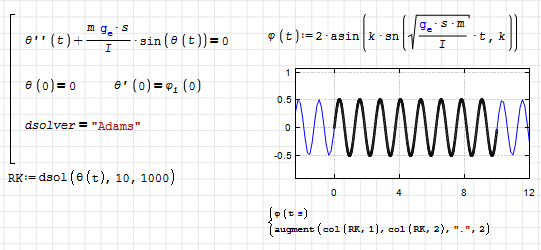
Frequency Analysis_v2.sm (189,94 KiB) descargado 1834 vez(es).
Best regards.
Alvaro.
Wrote
Hello again, I took the expression from the agllomerate of a couple of thesis work I discovered when studying the process. As the actual derrivation is quite complicated, but was common between papers, I didn't bother for it's confirmation.
Nevertheless, could you point me the error for the expression in phi(t)?
Thanks in advance.
Can you upload (or provide a link to) the two papers you mention?

sergio
clear
global g d m om0 fi0 lr k T
// accelerazione di gravità u.m. m,s
g=9.806
// INPUT
tit="Campana C1 (distesa)"
// distanza tra asse di rotazione e baricentro complessivo (campana+ ruota +ceppi)u.m. m
d=0.15
// massa totale(campana+ ruota +ceppi)u.m. kg
m=213
// momento d'inerzia rispetto asse rotazione u.m. kg,m
J=23.18
// metà angolo d'oscillazione %pi/2 per distesa
fimax=%pi/2+0.01
// FINE INPUT
// lunghezza pendolo equivalente
lr=J/(m*d)
om0=sqrt(g/lr)
//
k=sin(fimax/2)
// periodo
T=4/om0*%k(k)
disp(T,"T=" )
t=linspace(0,T,500)';
deff('[u]=myplus(x)','u=2*asin(k*ellipj(om0*(x+T/4),k))' )
fi=myplus(t);
//[u]=2*asin(k*ellipj(om0*t,k))
fi1=diag(numderivative(myplus,t));
fi2=-om0^2*sin(fi);
f=1/T
omega=2*%pi/T
// forze all'asse di rotazione
H=-m*d*(fi2.*cos(fi)-fi1.^2 .*sin(fi));
V= m*g+m*d*(fi2.*sin(fi)+fi1.^2 .*cos(fi));
// scomposizione in forzanti sinusoidali per la rappresentazione in serie di Fourier
aH0=1/T*intsplin(t,real(H))
aV0=1/T*intsplin(t,real(V))
n=20
for i=1:n
omegai=i*omega;
integrando1=H .*cos(omegai*t);
integrando2=H .*sin(omegai*t);
aH(i)=2/T*intsplin(t,real(integrando1));
bH(i)=2/T*intsplin(t,real(integrando2));
integrando3=V.*cos(omegai*t);
integrando4=V.*sin(omegai*t);
aV(i)=2/T*intsplin(t,real(integrando3));
bV(i)=2/T*intsplin(t,real(integrando4));
end
aH
bH
aV
bV
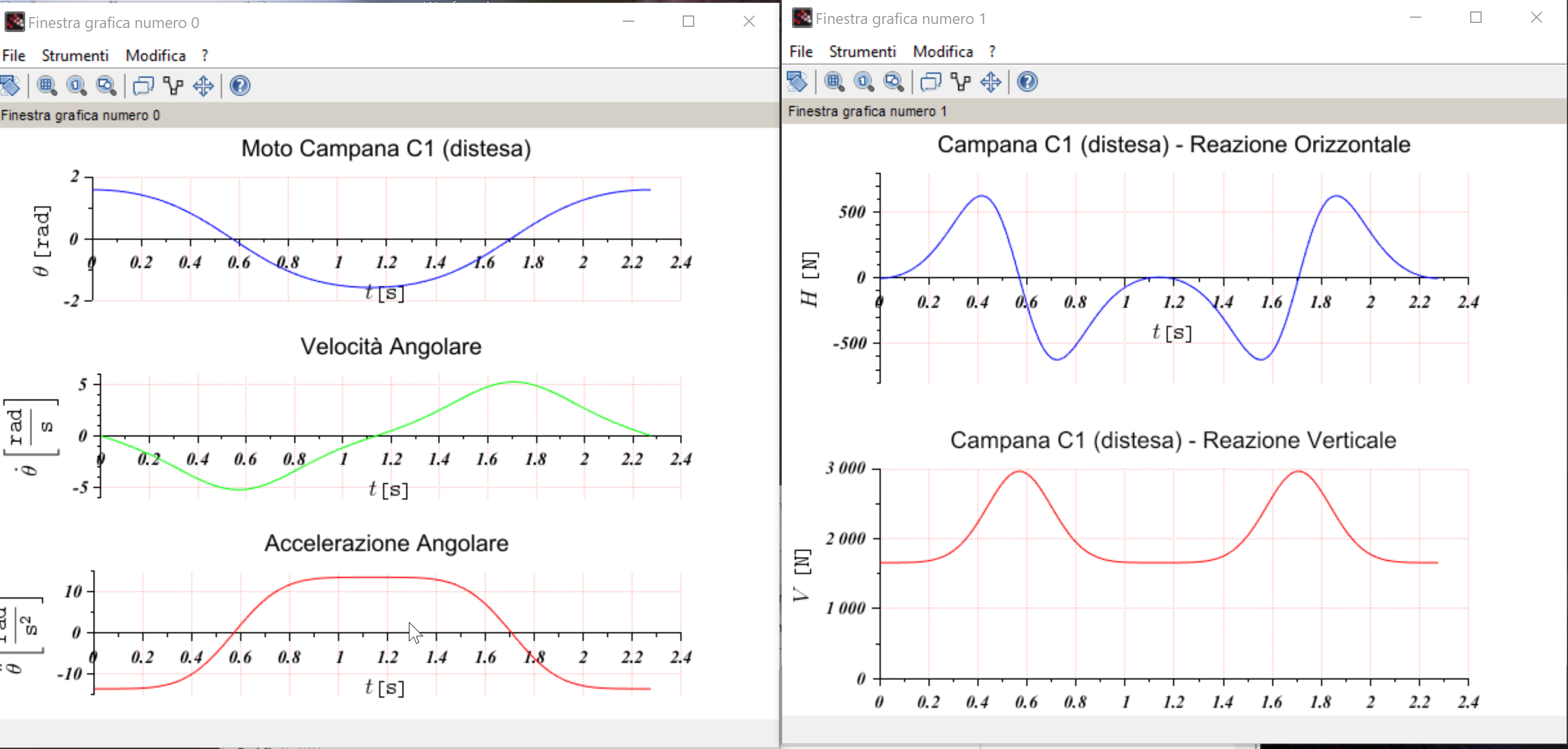
WroteA long time ago I addressed the problem by writing this scilab script ...
Hi Sergio. A solution, I guess that it is the same.
Campana di Pompelmo.pdf (524,95 KiB) descargado 1019 vez(es).
Campana di Pompelmo.sm (1,01 MiB) descargado 1816 vez(es).
Best regards.
Alvaro.
Cheers to all.
João
sergio
Campana di Pompelmo v2.sm (1,01 MiB) descargado 1865 vez(es).
Best regards.
Alvaro.
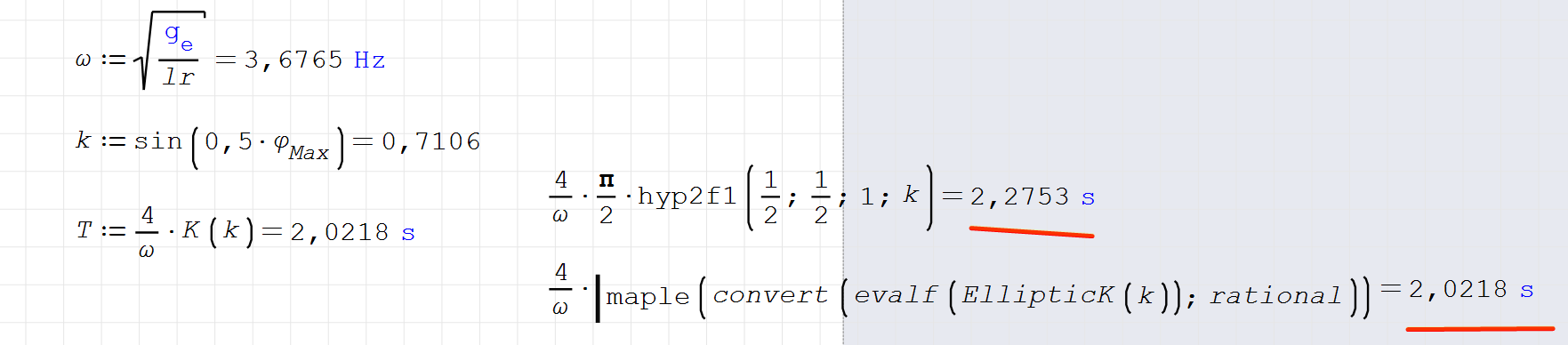
Only a annotation for the calculation of the "K" function: you gave two methods (indicating what you think preferable); The other method numerically provides the same value provided by Scilab and in fact two rather different periods of oscillation are obtained as indicated below (2.02 s against 2.27 s).
I have no mathematical knowledge so high to be able to evaluate this difference that does not seem to me to be of an exclusively numerical type.
sergio
https://functions.wolfram.com/EllipticIntegrals/EllipticK/26/01/01/
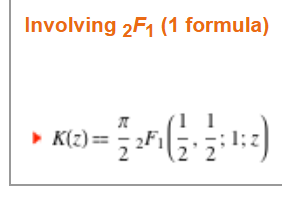
Edited: With this version of K it seems to work fine
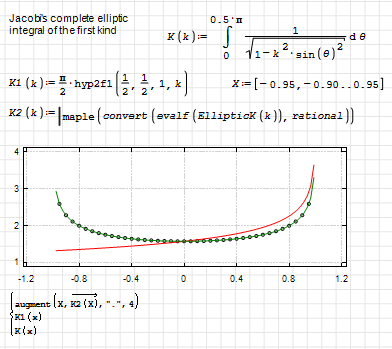
Campana di Pompelmo v3.sm (1,02 MiB) descargado 1818 vez(es).
Best regards.
Alvaro.
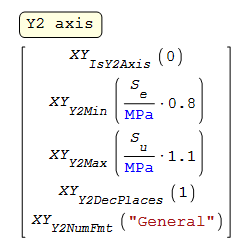 but it's not working any more.

WroteI used to set the plot X-Y using functions like this ... but it's not working any more.
See here: link
- Nuevos mensajes
- Sin mensajes nuevos