
Maxima Plugin - Messages

Draw2D() works.
Draw3D() also works.
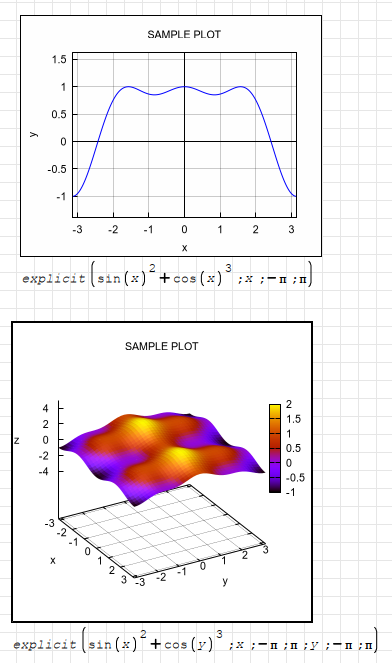
Draw3D() also works.
Edited 2025/6/20 22:18:20
4 users liked this post
sergio 2025/6/21 08:21:05, NDTM Amarasekera 2025/6/22 08:35:56, Martin Kraska 2025/6/21 09:52:50, Alvaro 2025/6/21 05:34:52
Actually, user fakemoses has fixed the Linux path issues in January 2024 (as can be seen in the history in the code repository). At that time there were still issues with the server side compilation of the plugin (the version from the extension manager didn't work, the local version of fakemoses worked). This seems to be fixed now from SMath side.
Thus, I encourage the Linuxing SMathers to give it a try.
Thus, I encourage the Linuxing SMathers to give it a try.
Technische Mechanik mit SMath Studio: https://link.springer.com/book/10.1007/978-3-658-50592-9
6 users liked this post
sergio 2025/6/21 15:03:53, Davide Carpi 2025/6/21 10:25:17, overlord 2025/6/21 11:54:21, Alvaro 2025/6/21 17:34:29, Andrey Ivashov 2025/6/21 20:54:18, NDTM Amarasekera 2025/6/22 08:35:44
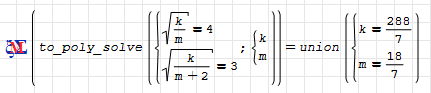
This doesn't work, yet it should.
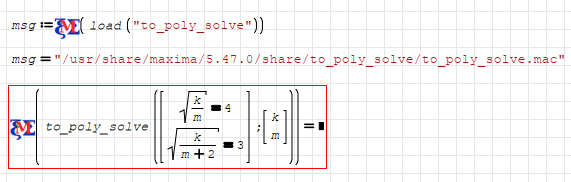
When I debugged it, obviously something is wrong with syntax.
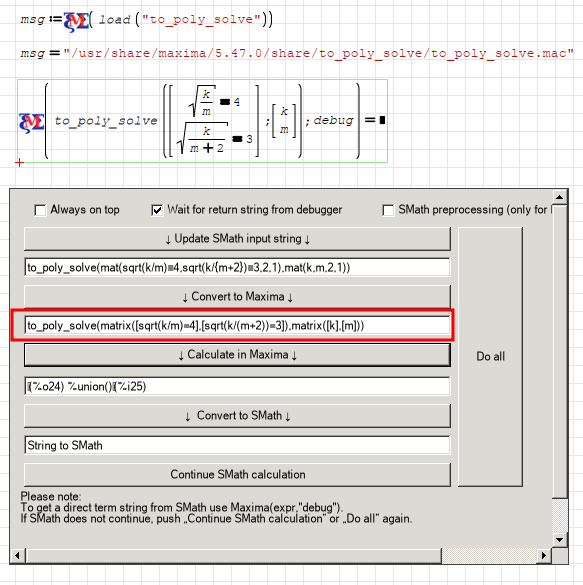
When I corrected it, it could calculate finally.
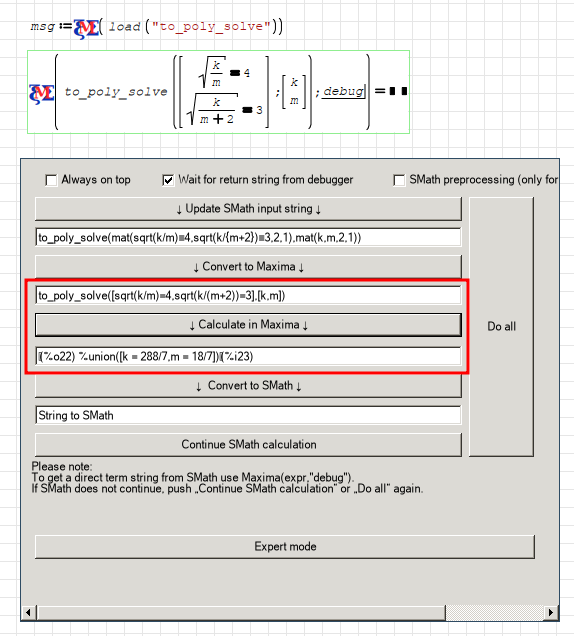
Otherwise, this equations can't be solved with smath-maxima.
When I debugged it, obviously something is wrong with syntax.
When I corrected it, it could calculate finally.
Otherwise, this equations can't be solved with smath-maxima.
according to the Maxima reference to_poly_solve wants lists or sets as arguments, not matrices.
Technische Mechanik mit SMath Studio: https://link.springer.com/book/10.1007/978-3-658-50592-9
1 users liked this post
overlord 2025/8/28 19:44:03
Wroteaccording to the Maxima reference to_poly_solve wants lists or sets as arguments, not matrices.
I thought it need matrices since all maxima Solve() examples in Reference Book are with matrix.
Thanks
Any opinion how to get rid of that union()?
Edited 2025/8/28 19:49:17
Solve is a special case, because it is not a direct call to Maxima's function solve() but a lot of work has been done to make it more forgivable in the input format, just like FindRoot(), there you can feed matrices or lists and I would not be surprised if also line() would work.
Also, solve() returns it result as a nested list of lists if there is more than one solution. Nested lists don't survive in SMath processing, so we had to replace the outer list by a matrix (row vector, for better optics).
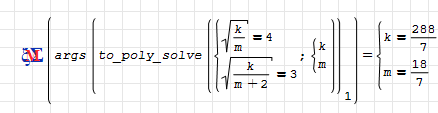
This all is not done if you use direct calls via the maxima function. The to_poly_function obviously uses the union() expression as wrapping construct for multiple solutions, which should be safe. Yet, you have to find out yourself, how to access the individual arguments of union() to access individual solutions. The arg() function does the job,
Also, solve() returns it result as a nested list of lists if there is more than one solution. Nested lists don't survive in SMath processing, so we had to replace the outer list by a matrix (row vector, for better optics).
This all is not done if you use direct calls via the maxima function. The to_poly_function obviously uses the union() expression as wrapping construct for multiple solutions, which should be safe. Yet, you have to find out yourself, how to access the individual arguments of union() to access individual solutions. The arg() function does the job,
Edited 2025/8/28 19:59:06
Technische Mechanik mit SMath Studio: https://link.springer.com/book/10.1007/978-3-658-50592-9
3 users liked this post
- New Posts
- No New Posts