
Cannot Calculate Error Message - Functions return a "Cannot calculate" error message - Messaggi

Several functions now return a "Cannot Calculate" error.
Any thoughts?
Thanks in advance!
Analysis - Fastener Group Elastic Vector Method.sm (20,57 KiB) scaricato 1360 volta(e).

Clear(r#) does the job BTW.
WroteSince updating to Version 0.99.6671 (07 April 2018)
Several functions now return a "Cannot Calculate" error.
Any thoughts?
Thanks in advance!
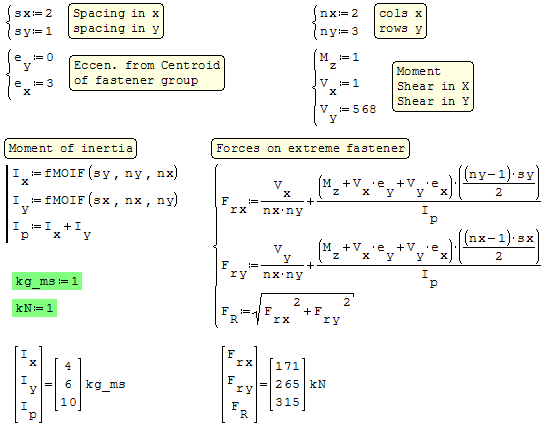
... Smath 6179 ... just make the input/output coherent wrt units
WroteSince updating to Version 0.99.6671 (07 April 2018)
Several functions now return a "Cannot Calculate" error.
Any thoughts?
Switching from 5346 => 6179 created lot of similar "errors",
all sorts of error messages, sometimes easy to correct.
My point here is otherwise, some work sheet can not be repaired.
Once a work sheet is corrupted, I must copy/paste section by section
in blank sheet, up until reconstruction is complete.
Moral: avoid too huge document !

Just remove first line from fMOIF(s#,n1#,n2#) definition:
r#:matrix(0,n1#)Why it was added? It does nothing for further calculation. What is a reason for it?
It is not a first time when I see code like matrix(0,0) and actually I do not understand what is it for... SMath Studio never had a possibility to generate a matrix of zero elements.
Best regards.
Wrote
It is not a first time when I see code like matrix(0,0) and actually I do not understand what is it for... SMath Studio never had a possibility to generate a matrix of zero elements.
I'm not sure what the intent was in this example, but I've used empty matrices before in Matlab. At least in my experiences, it's been used to represent an empty set. It can be useful when try to extract/filter/search through large data sets. You can perform the same sort of function in SMath but you either have to use the IsDefined() function and add an extra condition in your program or create a "dummy" value at index 1 then remember to ignore it.
WroteHello.
Just remove first line from fMOIF(s#,n1#,n2#) definition:r#:matrix(0,n1#)
Why it was added? It does nothing for further calculation. What is a reason for it?
It is not a first time when I see code like matrix(0,0) and actually I do not understand what is it for... SMath Studio never had a possibility to generate a matrix of zero elements.
Best regards.
I don't know why the topic starter did it. He seems to allocate a matrix with no rows and then uses linear indexing.
Initializing matrices with no rows or columns is required for subsequent build-up of the contents using stack or augment in a loop.
See Handbuch page 130/131 for examples.
Now that implicit loops are available, this type of generating matrices may loose popularity. Yet initializing with an empty matrix is a safe way to enable assignment to elements (as using Clear() would be).
CitazioneWhy it was added? It does nothing for further calculation. What is a reason for it?
It is not a first time when I see code like matrix(0,0) and actually I do not understand what is it for...
I used matrix(0,0) in this instance to make sure that r# is "clear". Now that I can use the clear() function I don't need to do this. However, I do use matrix(0,0) in other functions in order to "stack" or "augment" other matrices into the (0,0) matrix. Which is what Martin has described.
So will matrix(0,0) return and error in all cases now? If yes, what is the best way to build up a matrix that starts with nothing? I use this in other functions and I believe is also utilized in Martin's beam calculation snippet (great snippet by the way).
Wrotewhat is the best way to build up a matrix that starts with nothing?
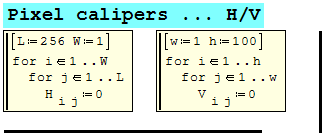
Matrix/vector don't start with nothing, they self-build from some sort of applied calculations.
If the algorithm is a recursive composition, it may be true that it needs an initial something.
A good such example is Mandelbrot [in Samples, partially solved].
On the other hand, many, very many visitors depose the problem with too little or insuuficient
indications to help track their route to failure.
Utilities Matrix Sequence[N].sm (20,26 KiB) scaricato 1033 volta(e).
Image Spot Dalmatian.sm (18,76 KiB) scaricato 1243 volta(e).
Wrotewhat is the best way to build up a matrix that starts with nothing?
Something that is nothing in numerical maths is NaN
NaN => Not a Number.
From recollection, Tom used NaN:= 10^-307
because Tom didn't purchase DAEP [2003 ... $ 350]
Sorry to be a pest, any thoughts on this?
Thanks again
Analysis - Beam - Simple Span - V3.sm (190,04 KiB) scaricato 1343 volta(e).
WroteI seem to have the same error statement with this worksheet, but I don't define an "empty" matrix.
Sorry to be a pest, any thoughts on this?
Thanks again
Analysis - Beam - Simple Span - V3.sm (190,04 KiB) scaricato 1343 volta(e).
This is because in GetMax you are trying to build a matrix on x1# (that seems to be a variable named x#, this triggers the error)
Use Clear(x1#) or don't pass the second argument (why was needed?)
WroteI seem to have the same error statement with this worksheet, but I don't define an "empty" matrix.
Smath 6179 generates no error "can not calculate"
- Nuovi post
- Nessun nuovo post