
1 pagine (4 elementi)
i as formal argument in function definitions - Messaggi

I encountered the problem that I cannot use i as formal argument in function definitions. This is surprising to me, since i can be redefined in other situations (eg. by use as loop variable). May be this has been discussed earlier, but I don't find a hint.
Seems like one more oddity that is hard to explain. Or did I miss something?
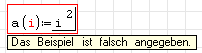
Seems like one more oddity that is hard to explain. Or did I miss something?
Technische Mechanik mit SMath Studio: https://link.springer.com/book/10.1007/978-3-658-50592-9

Hello Martin,
I remember this issue has been mentioned here more than few times. See for instance this one Treatment-of-imaginary-unit.
Regards,
Radovan
I remember this issue has been mentioned here more than few times. See for instance this one Treatment-of-imaginary-unit.
Regards,
Radovan
When Sisyphus climbed to the top of a hill, they said: "Wrong boulder!"
2 utenti hanno apprezzato questo post
WroteHello Martin,
I remember this issue has been mentioned here more than few times. See for instance this one Treatment-of-imaginary-unit.
Regards,
Radovan
Thank you, Radovan. I see that the resistance to i as formal parameter is hardwired in order to cover leaks in the optimization procedures. Would the formal parameters really be treated as local variables then life would be much easier.
In my handbook I frequently use i as variable name (loop counters, indices) in the hope that one day Andrey will find a clean solution that allows for unlimited use of i as variable name.
With a little criminal energy there is a workaround, see attachment. The trick is visible but not obvious and therefore cannot be recommended for regular use.
Martin

Technische Mechanik mit SMath Studio: https://link.springer.com/book/10.1007/978-3-658-50592-9
WroteWith a little criminal energy there is a workaround, see attachment. The trick is visible but not obvious and therefore cannot be recommended for regular use.
The i. (dot after i - it can be seen by looking at the braces, they are a bit larger) is of the most troublesome and problematic issue to explain to beginners (is there an index or not? it looks like one, why it is not working as expected?? etc.) During all these years I am always having the same kind of questions and explanations to my students ,over and over, about "literal", "real one", "fictive", "dot as a part of variable name" and all kinds of errors in spite of endless repeating of that.
Regards,
Radovan
When Sisyphus climbed to the top of a hill, they said: "Wrong boulder!"
1 pagine (4 elementi)
- Nuovi post
- Nessun nuovo post