
Assembling stiffness matrices - Mensajes

I have two local stiffness matrices (6x6) calculated in SMath. Now I want to assemble them into a single global stiffness matrix (8x8):

Red numbers represent degrees of freedom. The assemblage is done in such a way that terms from these two local matrices which correspond to the same degree of freedom have to be added. So for example I take the term 5-5 (column numbered as 5 and row numbered as 5) from k1 and add it to the term 5-5 from k2. The problem is that these terms are located in different parts of the matrices. For example aforementioned term 5-5 is actually in the 3rd column and 3rd row of the first matrix, in the 5th column and 5th row of the second matrix and goes to the same place (5th column, 5th row) of the global matrix. Of course I can do it manually but it's a lot of work for larger matrices (even here it takes some time). Is there an automated way to do it in SMath ?
Thanks in advance for your help.
Stiffness matrix.sm (40,39 KiB) descargado 1569 vez(es).
WroteThanks for reply. I've seen this sample. It's really great but I'm not sure how to proceed in my case. I attached the .sm file.
Stiffness matrix.sm (40,39 KiB) descargado 1569 vez(es).
There should be two ways for three methods I could think of.
I won't add algorithm style here, these are enough I guess.
You can also combine method1 and method2 but I wouldn't call this a new way.
Regards
Stiffness matrix_rev.sm (58,83 KiB) descargado 1497 vez(es).
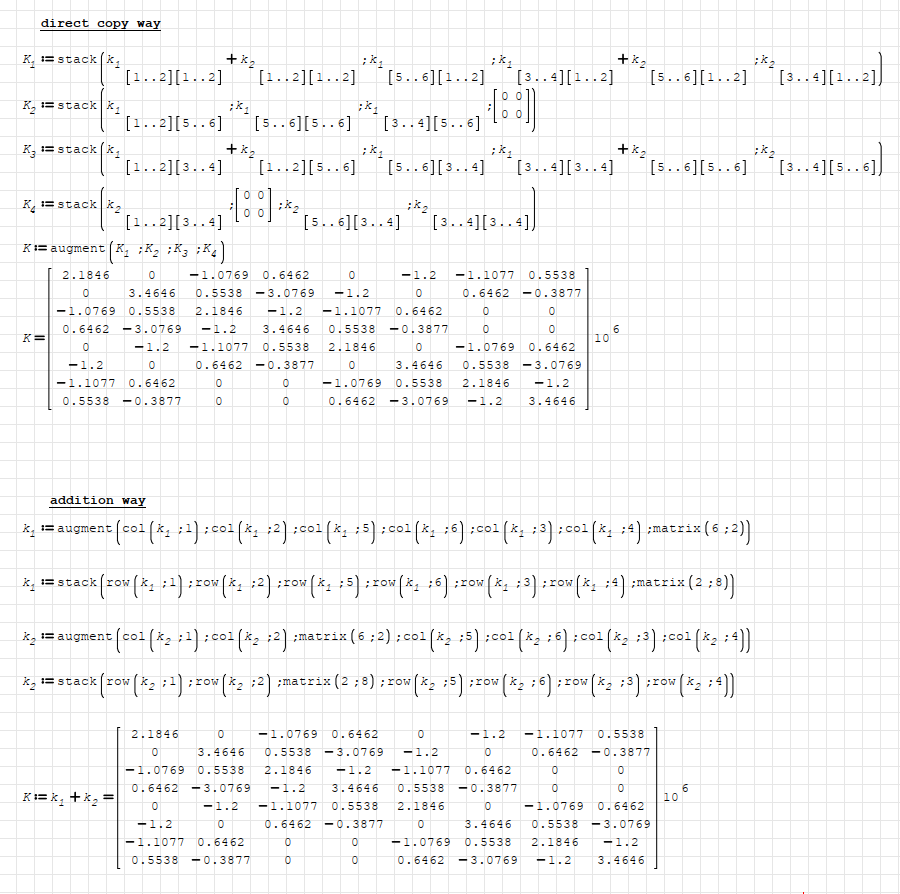
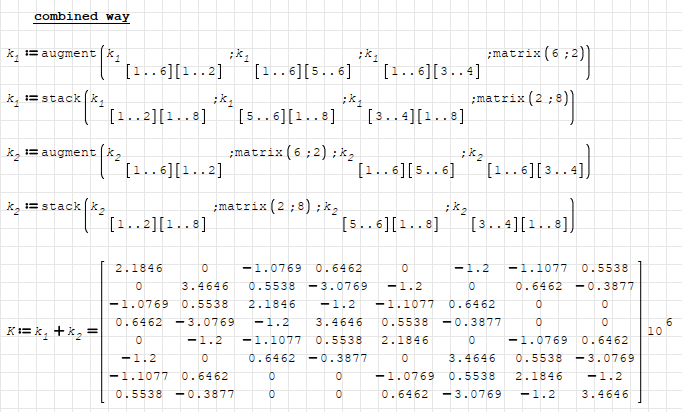
Stiffness matrix.sm (33,14 KiB) descargado 1547 vez(es).
Best regards.
Alvaro.
Best regards.
Alvaro.
WroteThank you very much. After the assembly, selected rows and columns of the global stiffness matrix have to be removed to account for boundary conditions. For example I would like to delete columns 1-4 and rows 1-4. So far I was just manually rewriting remaining terms to new matrix (K_new) but again it's quite tedious work. What's the best way to do it automatically in SMath ? Column and row numbers for deletion are not always ordered like that. For example it could be 2 an 5-8 as well.
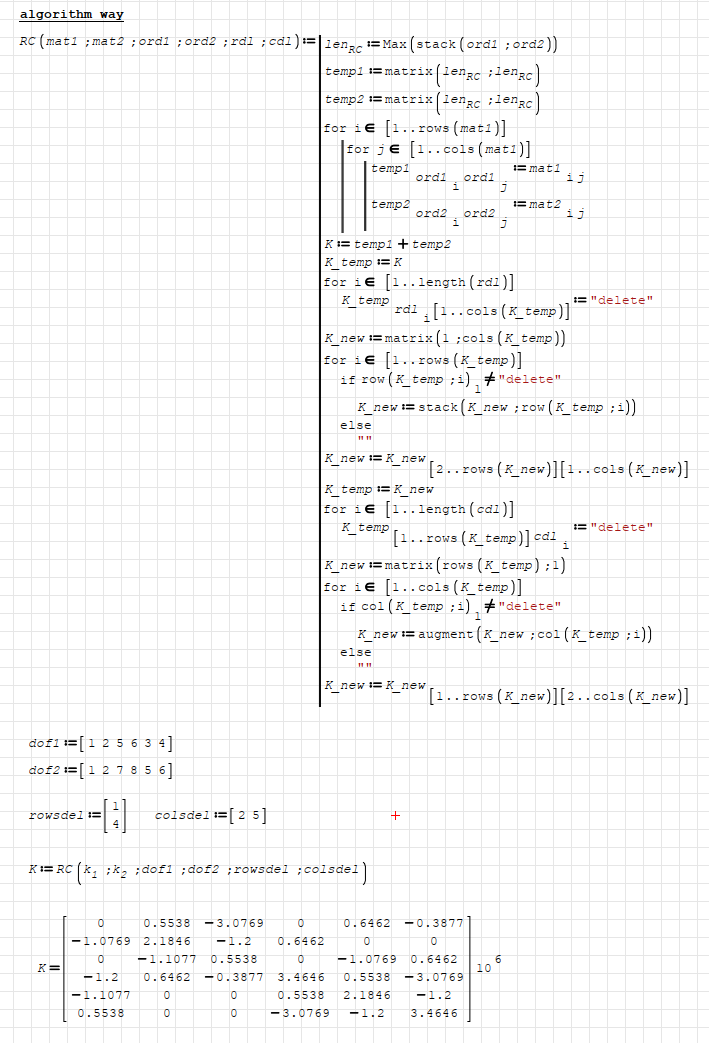
Is this what you are wishing to accomplish?
Specified rows and columns automatically removed from matrix.
There are also matrix extension commands to remove columns and rows.
But I wanted to write those functions without extension.
Regards
PS: If you want to see the results without removal,
assigning rowsdel=[9] and colsdel=[9] shall be enough.
The rowsdel and colsdel should always be a vector.
Stiffness matrix_rev2.sm (45,88 KiB) descargado 1476 vez(es).
WroteCheck alg(#,#,#) and minor(#,#,#), both are in the matrix toolbar.
They are both resident since my first SS 5346
duplicate of vminor from f(x) menu and duplicate of panel Minor,
as exemplified in disambiguation from Samples document.
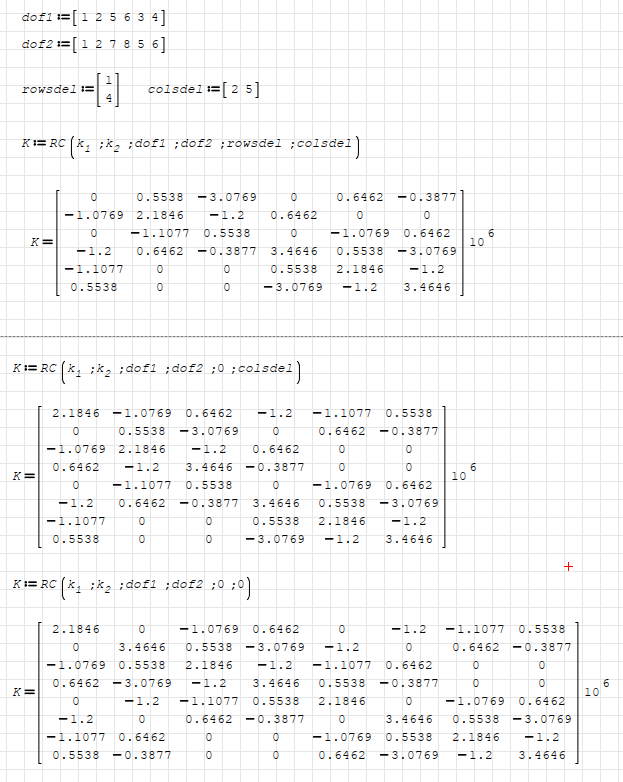
And much more conventional way for not removal implemented.
Entering zero for not remove wanted row or col is easier.
Regards
Stiffness matrix_rev3.sm (53,26 KiB) descargado 1513 vez(es).
01 - 1-element bar: 01-BARRAS DE 2 ELEMENTOS.sm (137,11 KiB) descargado 1499 vez(es).
02 - 2-element bar: 02-BARRAS DE 3 ELEMENTOS.sm (54,96 KiB) descargado 1481 vez(es).
03 - trusses: 03-ARMADURAS.sm (124,94 KiB) descargado 1476 vez(es).
04 - 1-element frame: 04-PORTICO DE 1 BARRA.sm (58,66 KiB) descargado 1404 vez(es).
05 - 2-element frame: 05-PORTICO DE 2 BARRAS.sm (60,4 KiB) descargado 1457 vez(es).
06 - 3-element frame: 06-PORTICO DE 3 BARRAS.sm (65,22 KiB) descargado 1482 vez(es).
07 - plates: 07-PLACAS.sm (132,32 KiB) descargado 1515 vez(es).
08 - axisymmetry: 08-AXISIMETRIA.sm (393,43 KiB) descargado 1499 vez(es).
In all of them you will find my algorithm for the assembly task. You will find also the reduced stiffness matrix, I created functions to delete specific rows and columns.
Documents {01,02}, {04,05,06} are the same, only with different number of rows (I created those this way to use it quickly in the SS Android version).
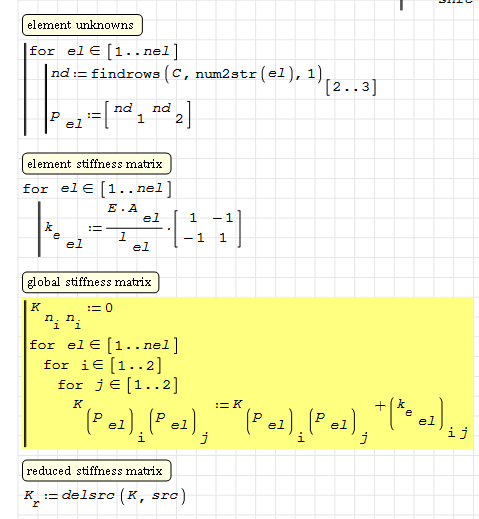
Thanks again, you guys are awesome, you really helped me a lot. And thank you Alvaro for sharing your FEM implementations in SMath. The 7th one (plates) is just what I'm working on now.
07-PLATES.sm (135,65 KiB) descargado 1522 vez(es).
07-PLATES.pdf (502,29 KiB) descargado 1021 vez(es).
07-PLATES (with code).pdf (540,7 KiB) descargado 1099 vez(es).
You can download it here:
https://1drv.ms/b/s!Ap2rcjsf-xok1woTCf8p26Qpw5Hn?e=SkhCnB
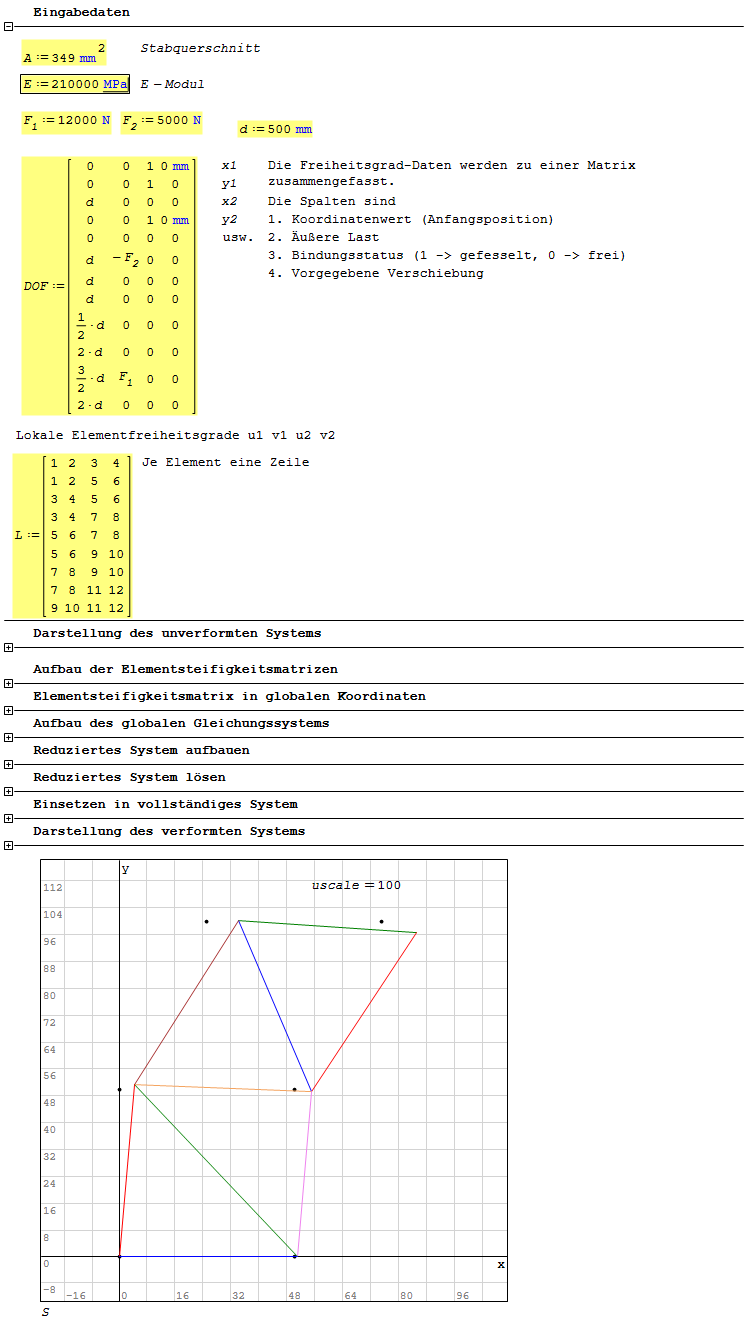
The input is via dof and connectivity tables.
Each bar element has 4 dofs defined by a line in the connectivity matrix
Each global dof is a line in the dof matrix with each containing
- initial position
- external nodal load
- constraint flag (1-constrained, 0-free)
- prescribed displacement (only relevant if dof is constrained, can be nonzero)
Fachwerk UE2.sm (80,72 KiB) descargado 1520 vez(es).
WroteRed numbers represent degrees of freedom. The assemblage is done in such a way that terms from these two local matrices which correspond to the same degree of freedom have to be added. So for example I take the term 5-5 (column numbered as 5 and row numbered as 5) from k1 and add it to the term 5-5 from k2. The problem is that these terms are located in different parts of the matrices. For example aforementioned term 5-5 is actually in the 3rd column and 3rd row of the first matrix, in the 5th column and 5th row of the second matrix and goes to the same place (5th column, 5th row) of the global matrix. Of course I can do it manually but it's a lot of work for larger matrices (even here it takes some time). Is there an automated way to do it in SMath ?
Stifness matrix is not my discipline.
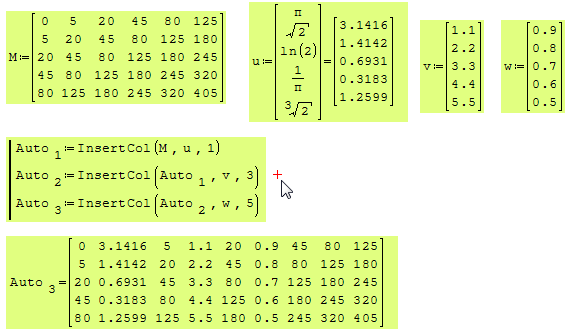
From square/rectangular matrix ...
You can extract paired symmetric [5,5] or asymmetric [2,5] col/row.
Extract...single col, single row.
You can delete pair wise single col/row or any cols/rows in any combination.
You can delete only col or only row.
Once in hand the new matrix, you can insert valued col or row
or col & row anywhere in the new matrix.
That step is one by one at this point of my proposal, might be automated.
All that from minimalist handling matrix.
Your 'K' matrices don't speak to me ... more visible example would help.
Cheers ... Jean
Wrotemight be automated.
... ½ automated left for clic/clic/DONE gurus.
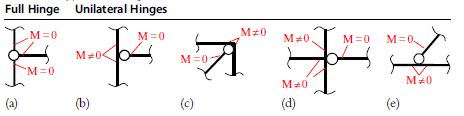
Seems to be a few 2D truss projects, and some 2D Frame projects, but I'm curious about internal releases for frame structures.
Maybe someone can save me a deep dive into my old text books.
Thanks
WroteAny ideas on how to integrate internal releases into the 2D Frame stiffness matrices?
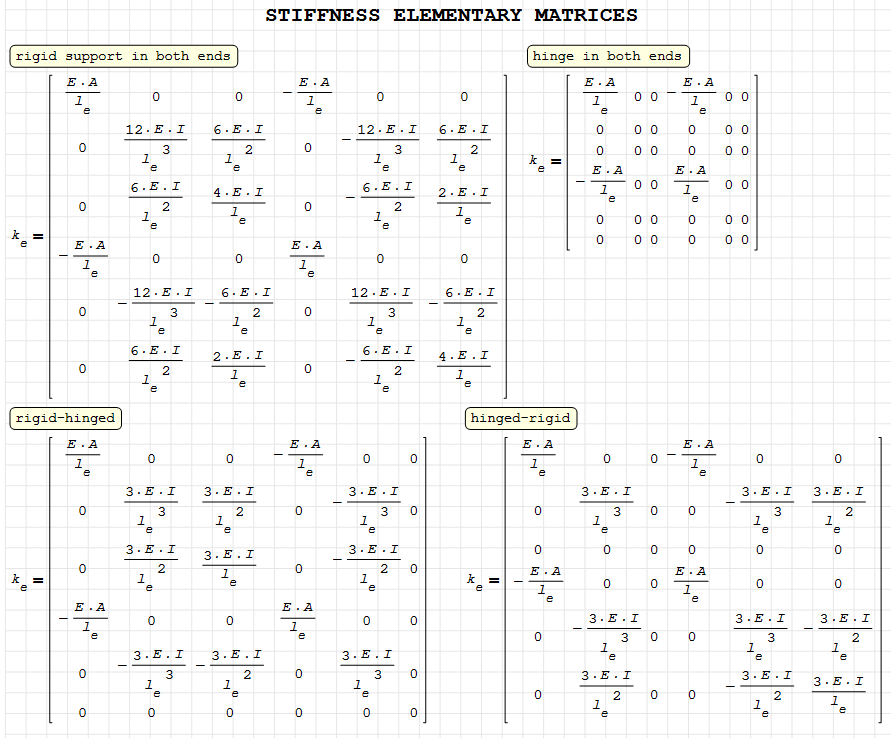
Here I attach the other elementary stiffness matrices. I didn't tested these in FE programs (always worked with rigid-rigid ends in FE), but when I was student of indeterminate structures (displacement method) I did some demonstrations of stiffness factors for each case, and these are well verified (except for the last page, that I wrote a few minutes ago just to complete the case of unitary rotation about the hinge (not needed for displacement method)).
Having in mind that the k(i,j) element of an elementary stiffness matrix is the reaction value in the j-displacement direction caused by an i-unitary displacement, you could trace each of the values found in my demonstrations.
Hope it works for you and please comment if it did once you have implemented it into your code.
I attach those demonstrations too (in spanish, but structural mechanics is a universal language :d )
Regards!
Alvaro
Archivo no encontrado.Archivo no encontrado.
Wrote
Here I attach the other elementary stiffness matrices. I didn't tested these in FE programs (always worked with rigid-rigid ends in FE), but when I was student of indeterminate structures (displacement method) I did some demonstrations of stiffness factors for each case, and these are well verified (except for the last page, that I wrote a few minutes ago just to complete the case of unitary rotation about the hinge (not needed for displacement method)).
Having in mind that the k(i,j) element of an elementary stiffness matrix is the reaction value in the j-displacement direction caused by an i-unitary displacement, you could trace each of the values found in my demonstrations.
Hope it works for you and please comment if it did once you have implemented it into your code.
I attach those demonstrations too (in spanish, but structural mechanics is a universal language :d )
Regards!
Alvaro
This worked perfectly, thanks Alvaro! For now I just added an extra vector that set a condition for each member and had the stiffness and transformation matrix builder you have in your example cycle through an if statement to decide which stiffness matrix was used for each member as the total stiffness matrix is built. Attached is the modified version of your 3-beam frame example, which technically could be used for any number of beams.
I verified the results in the attached file with some 2D structural analysis software and it appears to be correct correct. Take a look and let me know. I'm sure there are more systematic ways of accomplishing this, but as a proof of concept, I'm happy with the results.
Working Stiffness Matrix Idea - Internal Releases.sm (100,3 KiB) descargado 1631 vez(es).
Now I just need to blend some of the graphical and data input ideas from other users and make this a more functional mini 2Dstructural analysis tool. Would be nice to get working standalone exe via SMath Viewer.
- Nuevos mensajes
- Sin mensajes nuevos