
1 páginas (8 elementos)
Vector Addition (scalar, direction) with vector result - How to add vectors (scalar, direction) and get a vector result - Mensajes

Hello all
I have two vectors with scalar and direction that I want to add and get a resulting vector that has scalar and direction. I can't seem to figure this out? Basically I have a force problem that I am solving for and I figured this would be best done by adding the vectors to get the resulting force however I can't seem to figure this out on SMath.
Thank-you to all who answer.

Can you post an example (from literature or made by you)?
If you like my plugins please consider to support the program buying a license; for personal contributions to me: paypal.me/dcprojects
oops I never tried this, I think he means this
http://www.1728.org/vectors.htm
I might be wrong but SMath does not calculate sum of vectors given in polar coordinates correctly
http://www.1728.org/vectors.htm
I might be wrong but SMath does not calculate sum of vectors given in polar coordinates correctly
A 1 usuarios les gustó este mensaje
Davide Carpi 20/9/2013 17:57:00
Actually, there are several ways to calculate vector sums. In 2D the most natural way for vectors given in polar form is using complex numbers. In mechanics, we usually transform to cartesian components, as this can be generalized to 3D.
Unfortunately, this example reveals that the handling of sums in Maxima plugin is very weak at the moment. Therefore, we have to "surrender" for the moment.
Example adding 2D vectors.sm (14,14 KiB) descargado 1459 vez(es).
Unfortunately, this example reveals that the handling of sums in Maxima plugin is very weak at the moment. Therefore, we have to "surrender" for the moment.
Example adding 2D vectors.sm (14,14 KiB) descargado 1459 vez(es).
Technische Mechanik mit SMath Studio: https://link.springer.com/book/10.1007/978-3-658-50592-9
Wroteoops I never tried this, I think he means this
http://www.1728.org/vectors.htm
I might be wrong but SMath does not calculate sum of vectors given in polar coordinates correctly
I think you are right; BTW is a quite simple problem, so one can build his own function, with the most appropriate input standard that he think better and, like has Martin said, there are several ways to process the problem

If you like my plugins please consider to support the program buying a license; for personal contributions to me: paypal.me/dcprojects
I think the question is about adding vectors entered in polar form as in the first expression. Note that SMath does not return the correct result.

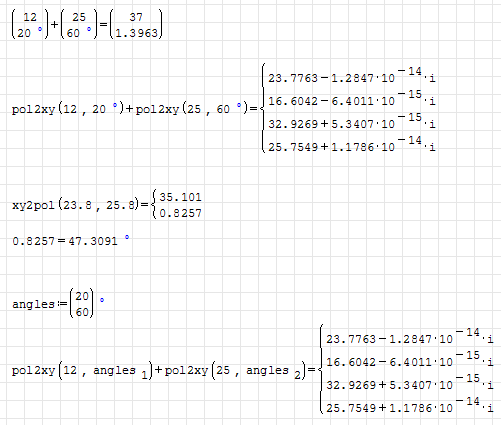
WroteNote that SMath does not return the correct result.
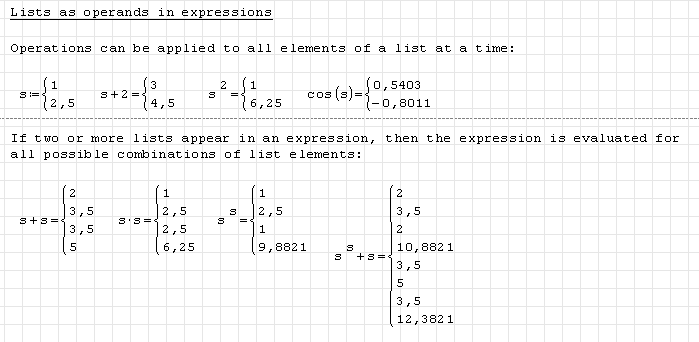
Lists and list operations are not a good representation for vectors and vector operations. If lists obtained by pol2xy are to be added, they must be converted to vectors using sys2mat().
Technische Mechanik mit SMath Studio: https://link.springer.com/book/10.1007/978-3-658-50592-9
@ioan92
Nice explanation on how to get a result. The point of the original question, I think, was a direct way using only polar notation provided by SMath
@mkraska
I forgot to apply sys2mat to an expression involving more than one system, anyway the result of that sum is incorrect.
Nice explanation on how to get a result. The point of the original question, I think, was a direct way using only polar notation provided by SMath
@mkraska
I forgot to apply sys2mat to an expression involving more than one system, anyway the result of that sum is incorrect.
A 1 usuarios les gustó este mensaje
ioan92 21/9/2013 8:57:00
1 páginas (8 elementos)
- Nuevos mensajes
- Sin mensajes nuevos