1 páginas (9 elementos)
Hessian - Mensajes


:d
Russia ☭ forever, Viacheslav N. Mezentsev
A 1 usuarios les gustó este mensaje
Radovan Omorjan 2/10/2012 3:04:00
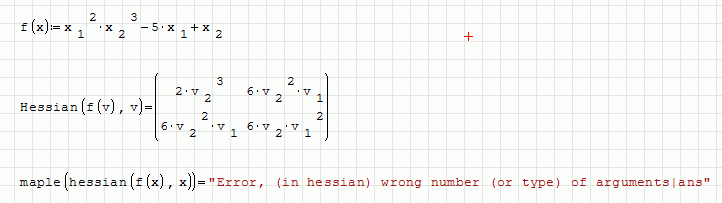
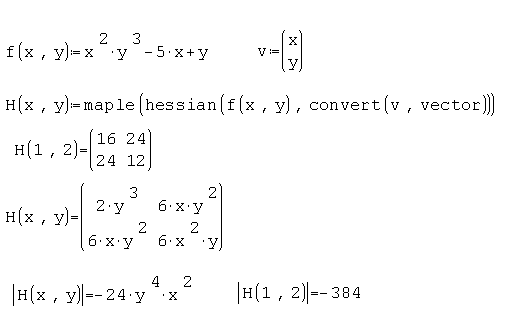
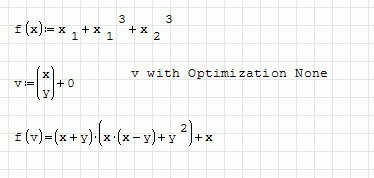
It is not a good idea to use smath subscripts in maple. Here I need to think a little bit.
Russia ☭ forever, Viacheslav N. Mezentsev
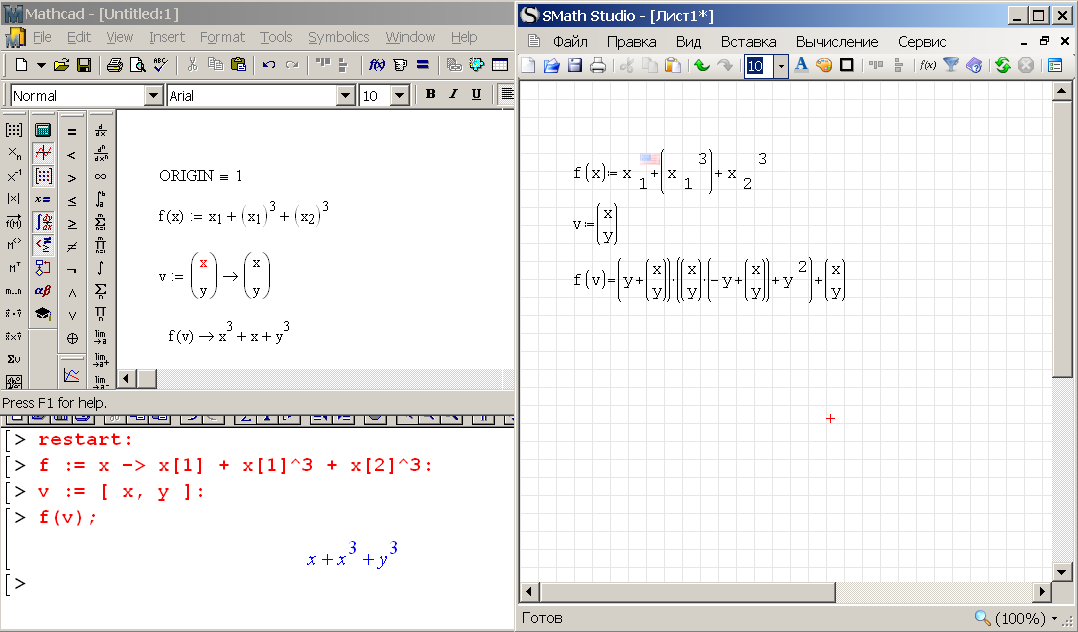
Nice bug. This a workaround.
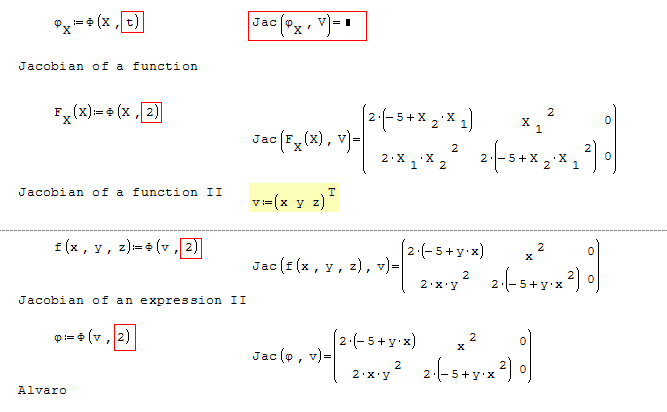
I think that this is the better way to work with the Jacobian.
Alvaro.
Jacobian.sm (22,57 KiB) descargado 1640 vez(es).
Alvaro.
Jacobian.sm (22,57 KiB) descargado 1640 vez(es).

Hello Alvaro,
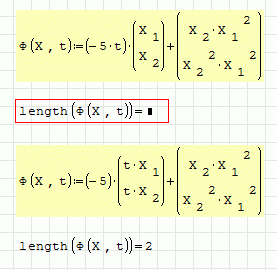
But what to do if the vector function is defined this way?
[MATH=eng]Φ(X,t):-5*t*mat(el(X,1),el(X,2),2,1)+mat(el(X,2)*el(X,1)^2,el(X,2)^2*el(X,1)^2,2,1)[/MATH]
It will not work until t is a constant (scalar). Take a look at the pictures please.
Regards,
Radovan
But what to do if the vector function is defined this way?
[MATH=eng]Φ(X,t):-5*t*mat(el(X,1),el(X,2),2,1)+mat(el(X,2)*el(X,1)^2,el(X,2)^2*el(X,1)^2,2,1)[/MATH]
It will not work until t is a constant (scalar). Take a look at the pictures please.
Regards,
Radovan
When Sisyphus climbed to the top of a hill, they said: "Wrong boulder!"
What doesn´t works is length, so can't include symbolic scalars outside vectors.
Regards.
Regards.
Hello Alvaro,
Actually, that is the point. I think that's the problem of the symbolic engine.
The first one gives the symbolic result
[MATH=eng](-5*t)*mat(el(X,1),el(X,2),2,1)+mat(el(X,2)*el(X,1)^2,el(X,2)^2*el(X,1),2,1)=mat(-5*el(X,1),-5*el(X,2),2,1)*t+mat(el(X,2)*el(X,1)^2,el(X,2)^2*el(X,1),2,1)[/MATH]
and the result is not a vector, therefore length() does not work.
The second one actually give you the vector symbolically
[MATH=eng](-5)*mat(el(X,1)*t,el(X,2)*t,2,1)+mat(el(X,2)*el(X,1)^2,el(X,2)^2*el(X,1),2,1)=mat(el(X,1)*(-5*t+el(X,2)*el(X,1)),el(X,2)*(-5*t+el(X,2)*el(X,1)),2,1)[/MATH]
Maybe the solution would be to say in advance what the variable t was - either scalar, vector or matrix. Something like "assume". If SMath assumed that t was a scalar, it should behave in accordance to that and give you the second correct result.
Regards,
Radovan
When Sisyphus climbed to the top of a hill, they said: "Wrong boulder!"
1 páginas (9 elementos)
- Nuevos mensajes
- Sin mensajes nuevos