
1 páginas (5 elementos)
Advanced range function - A function that improves the normal range(). - Mensajes

A function that improves the normal range().
This is almost a normal range(), but it can plot a span from non-integers with a configurable step. Moreover, any numbers can be substituted inside the interval.
There are examples inside.


Get Range 3.sm (718,54 KiB) descargado 1474 vez(es).
You can put the file in the snippet folder to quickly add it to any project.
I don't know much English, so I write through a translator. Russian forum is closed so I write here.
This is almost a normal range(), but it can plot a span from non-integers with a configurable step. Moreover, any numbers can be substituted inside the interval.
There are examples inside.
Get Range 3.sm (718,54 KiB) descargado 1474 vez(es).
You can put the file in the snippet folder to quickly add it to any project.
I don't know much English, so I write through a translator. Russian forum is closed so I write here.
As I understand, the main objective is to have ranges with custom extra values.
Yet, given the size of the procedure, it must be much smarter than this:
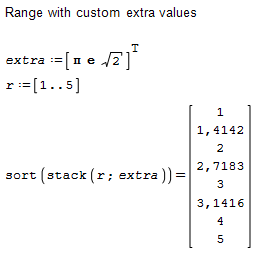
re.sm (3,55 KiB) descargado 1392 vez(es).
Yet, given the size of the procedure, it must be much smarter than this:
re.sm (3,55 KiB) descargado 1392 vez(es).
Technische Mechanik mit SMath Studio: https://link.springer.com/book/10.1007/978-3-658-50592-9
A 1 usuarios les gustó este mensaje
SteelCat 16/5/2020 17:11:00
WroteAs I understand, the main objective is to have ranges with custom extra values.
Yet, given the size of the procedure, it must be much smarter than this:
re.sm (3,55 KiB) descargado 1392 vez(es).
Wow, this is cool and so easy. I didn't realize it before.
And I understood why this option did not suit me. I needed to build a range that could start with a non-integer and end with a non-integer, but the main step should be an integer. That is, so that you can start with 0.99, and then the step becomes an integer. At the same time, it was necessary to change the step.
And inside non-integers as a bonus, just because the sorting function can do it.
There is probably a simpler solution, but I haven't found it.

I just needed a similar feature at the University and decided to share it here. Maybe it will be useful to someone.
WroteI needed to build a range that could start with a non-integer and end with a non-integer, but the main step should be an integer. That is, so that you can start with 0.99, and then the step becomes an integer. At the same time, it was necessary to change the step.
And inside non-integers as a bonus, just because the sorting function can do it.
There is probably a simpler solution, but I haven't found it.
I just needed a similar feature at the University and decided to share it here. Maybe it will be useful to someone.
This might be a first approach...
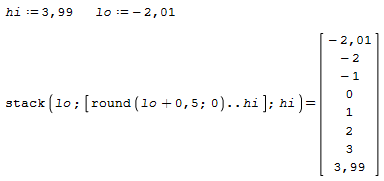
re1.sm (3,28 KiB) descargado 1439 vez(es).
Technische Mechanik mit SMath Studio: https://link.springer.com/book/10.1007/978-3-658-50592-9
A 1 usuarios les gustó este mensaje
frapuano 16/5/2020 17:03:00
1 páginas (5 elementos)
- Nuevos mensajes
- Sin mensajes nuevos